If you require a practical rule of me, I will present you with this: ‘Whenever you feel an impulse to perpetrate a piece of exceptionally fine writing, obey it—whole-heartedly—and delete it before sending your manuscript to press. Murder your darlings.’
—Arthur Quiller-Couch, On the Art of Writing
The first cut is always the deepest, words that ring out, tirelessly, like church-bells that have known no other fate. To write an encore is no easy feat, and the paralysis is never in the pen, but Bittersweet was anything but. It rang true, and fluid, with seamless ease, the entire experience of writing as slick as the skin on a plum. The content has weight, the story has moral, and it will be heard. What lies unseen are the thousands of pages derived from lived experience that led to the final work—a total of one-hundred recipes, a dedication, and an epitaph. Some of these pages were left on the floor, others burnt, their recipes saved. And no one was spared. The process of editing and refinement smoothed over any cracks. But if there is a director’s cut, there must also be a writer’s cut.
Toxin. The X that marks the spot, that licks the wound, that allows the bitterness to filter into my mouth and then out again. I don’t think I ever knew the meaning of it until I met him. Then, so suddenly, he had filtered into my bloodstream like the wine we would drink. I knew better, of course, for all my life I had been cautious not to leave red stains. But an intimate act creates a special bond. And darling, once he is in your system, bitterness, will make its move from inside you.
—uncut, ‘Bitter’ from Bittersweet (2026)


The anguishing act of an edit, a kill your darlings situation—where it isn’t even the strongest words that survive, or about cutting the implicit fat, but more a removal of the beloved in order to maintain semblance, clarity, and control, with just enough withheld to go onto the next work. We meet on the page, end on the page, and all that a reader requires is on this proverbial page, meanwhile, the world of the writer continues on.
Often, in the process of creation, I question my own decisions. And the answers I seek almost always are found in bitterness. Have I constructed with enough balance? Is it different to the others that have come before it? Does it sting, does it serve, but does it also save? Where do I put the anger? Where do I feel it in my body? Will they remember it? They must.
—uncut, ‘Bitter’ from Bittersweet (2026)
This recipe formed the foundation of Bittersweet, stemming from the first chapter, the dense, the dark, the deep—where life takes root. As such, it stands alone, but even fledgling seeds will push their way through the earth and into light. I used to watch my grandmother bake similar; how she’d twist each strand into tight knots of dough around her paper-thin-skinned hands, spurting Russian parables while she did it. This babka is nothing like hers; bitter, brooding, and captivating, it belongs more to Baba Yaga.
A lot exists inside bitterness that we cannot grasp, but only sense—light and dark, love and hate, desire and apathy, and with each mouthful, learning how to palate the contradictions.
— uncut, ‘Bitter’ from Bittersweet (2026)
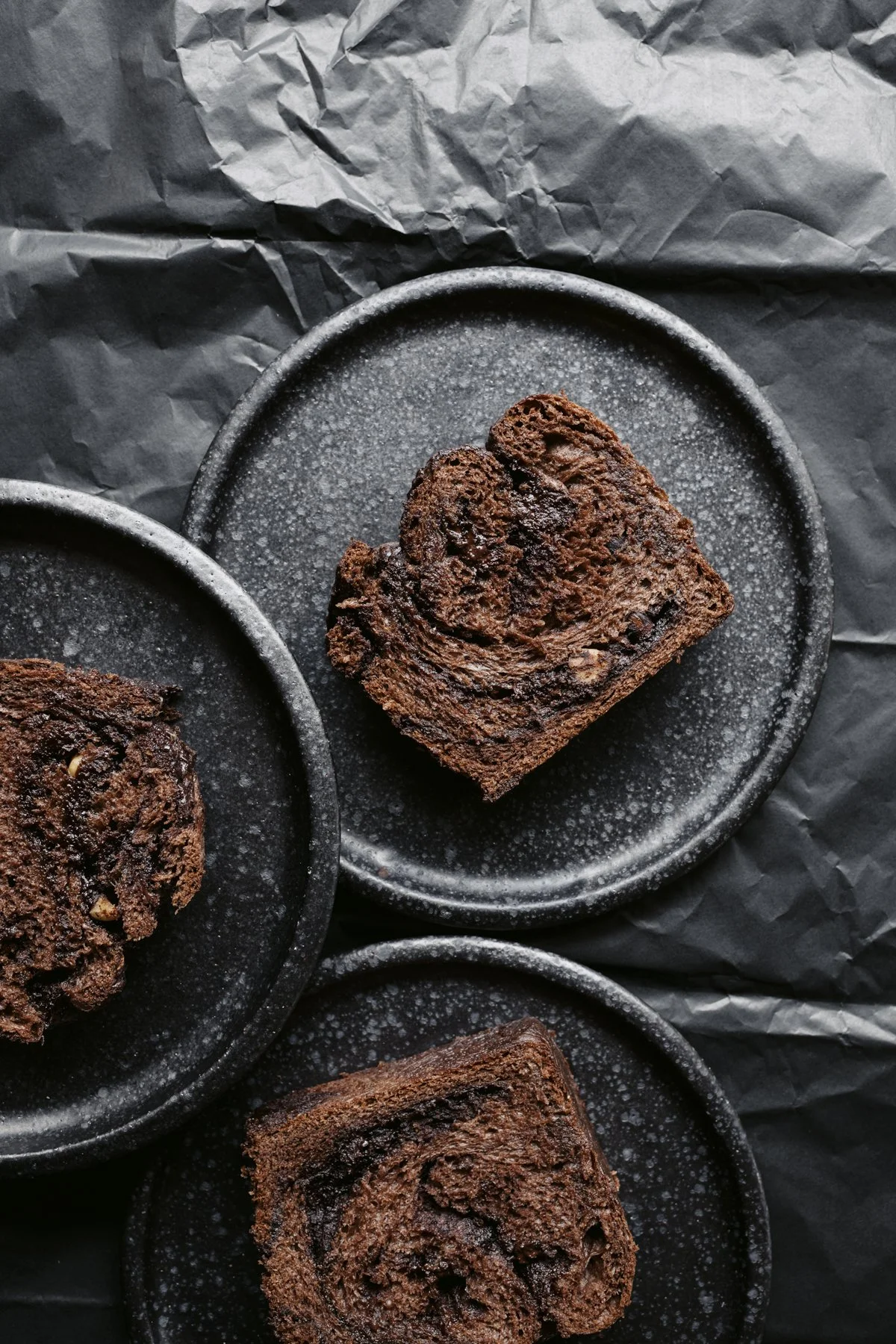
BRAIDED COCOA BRIOCHE
For the dough
2 ½ cups (315 g) all-purpose flour, ½ cup + 2 tablespoons (35 g) Dutch processed cocoa powder, ¼ cup (50 g) granulated sugar, 2 ½ teaspoons (7 g) instant dried yeast, ½ teaspoon salt, 3 large eggs (at room temperature), 1/3 cup (80 ml) whole milk (lightly warmed), ½ cup + 1 ½ tablespoons (135 g) unsalted butter (very soft at room temperature)
For the filling
½ cup (110 g) light brown sugar, 1/3 cup (25 g) Dutch processed cocoa powder, ½ teaspoon ground cinnamon, a pinch of salt, ¼ cup + 1 tablespoon (70 g) unsalted butter (melted), ¼ cup (45 g) dark chocolate (finely chopped), ¼ cup (35 g) roasted hazelnuts, walnuts, almonds, or pecans (finely chopped)
1 large egg whisked with 1 teaspoon of water and a pinch of salt (for the egg wash)
For the syrup
½ cup (100 g) granulated sugar
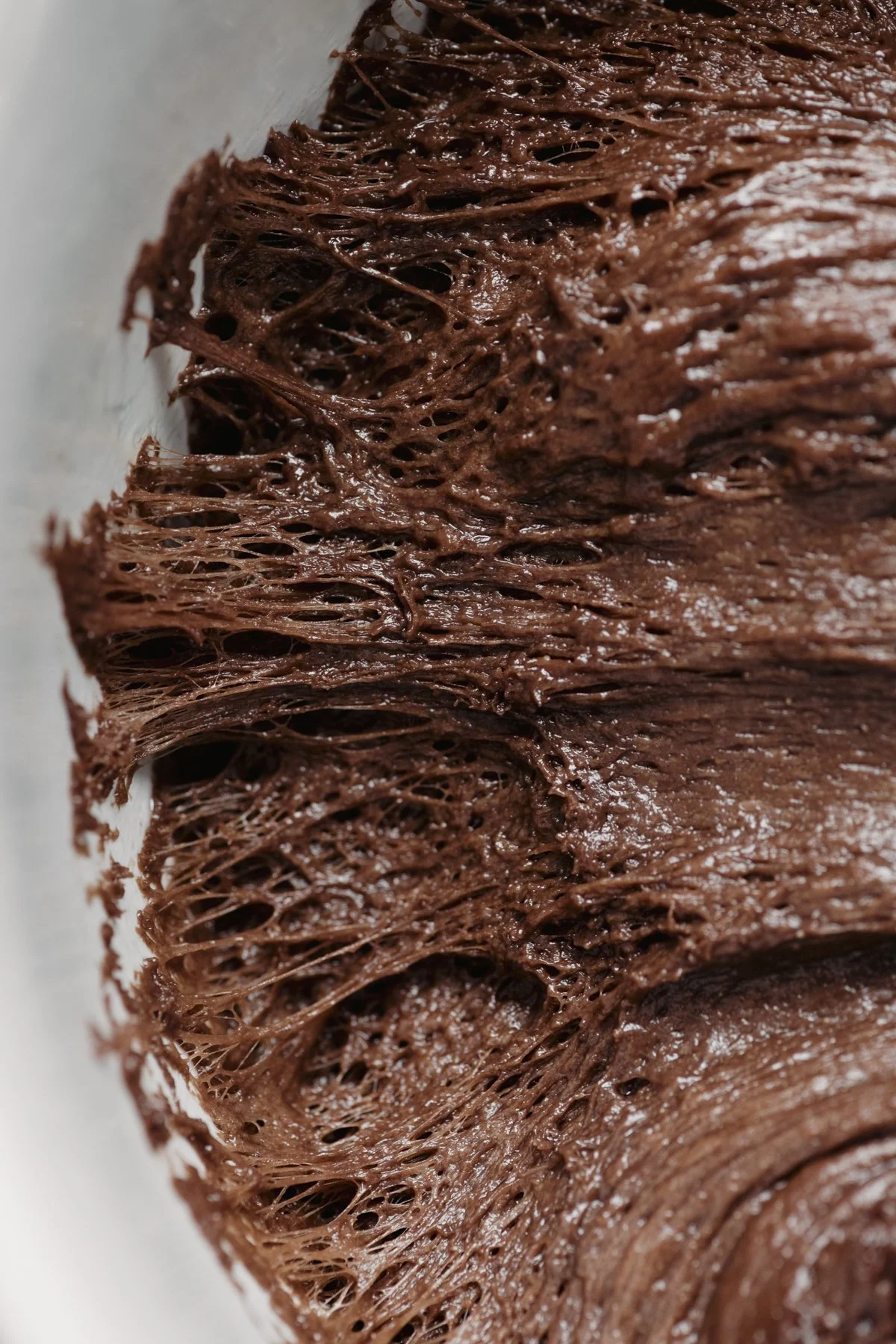
To make the dough, put the flour, cocoa, sugar, yeast, and salt into the bowl of a stand mixer that’s fitted with the dough hook attachment. Mix on low speed to combine, then add in the eggs and milk. Knead on medium speed for a few minutes until rough and shaggy, then raise the speed slightly. Continue to knead for a few more minutes until the dough has begun to catch and then pull away from the sides of the bowl. Add the butter, a tablespoon at a time, waiting until blended before adding in the next. Knead until silky and elastic, about 6 to 8 more minutes. Remove the bowl from the mixer. With some rotor-like pulls and stretches from the base of the dough with your hand, bring it together into a taut ball. Transfer to a lightly-greased large bowl, then cover, and leave to rise in a warm place until doubled in size, 1 ½ to 2 hours.
Grease and line a 9 x 5 x 3-inch (23 x 13 x 7-cm) loaf pan with parchment paper, leaving a sling over the long sides.
For the filling, combine the light brown sugar, cocoa, cinnamon, and salt in a medium bowl. Stir through the melted butter. The mixture should be thick, slick, and granular. Set aside.
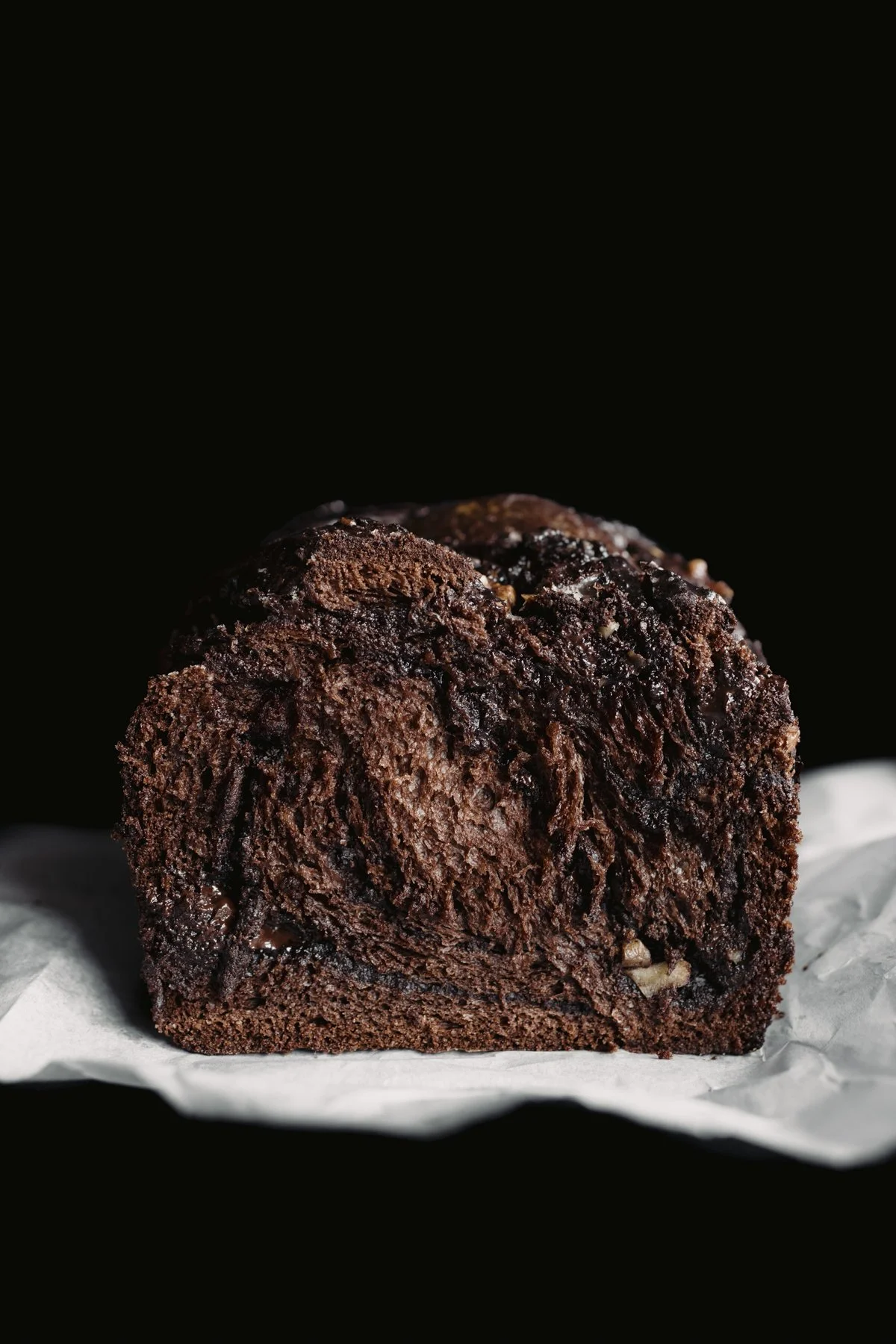
Next, flour a work surface, then transfer the dough onto it. Lightly dust the top. With a wooden pin, roll it into a 10 x 15-inch (27 x 40-cm) rectangle that’s about ¼ inch (.6-cm) thick—re-flouring and adjusting as needed. Slather on the filling (a spoon or offset palette knife is fine, fingers, better), then scatter with chocolate and nuts. Starting with the shortest side, roll the dough into a tight log. Pinch to seal, then flip, so the seam is facing down. Trim an inch off the ends, then with a sharp knife of scissors, slice it straight down the middle. The layers will be visible and you’ll have two halves. Twist the pieces over and under each other to form a braid. Place into the prepared pan, then cover, and again leave to rise—but this time until just under doubled in size, about 30 minutes. Meanwhile, position a rack to the middle of the oven, and pre-heat it to 350F (180C).
Tenderly brush the loaf with egg wash. Bake for 40 to 45 minutes, until risen, and deep with color. A skewer inserted into the thickest part should come out clean—but differentiate between the doneness of the dough and the chocolate filling which will remain sticky and molten. Cool on a wire rack while you make the syrup.
For the syrup, combine the sugar and ¼ cup + 1 tablespoon (75 ml) of water in a small saucepan. Bring to a boil over medium heat, stirring often to help dissolve the granules. Pour the syrup over the loaf and stand until absorbed, before lifting the loaf out and onto the rack.
Serve warm or at room temperature, sliced with restraint so as not to tear the delicate inside. This should be eaten on the day of making, but leftovers can be stored in the refrigerator, wrapped, for about 3 days. Warm slightly, for its best.
THE SIXTH SENSE
Additional bitterness can be forced into the chocolate by burning it. Scatter the pieces for filling onto a lined baking sheet and roast, undisturbed, at 400F (200C) for 10 to 12 minutes, or until darkened around the edges. Allow to cool and harden before proceeding with the recipe. The chocolate will seize under high heat, transforming into a brittle shell of its original self. It’s a simple change, but a drastic one.